

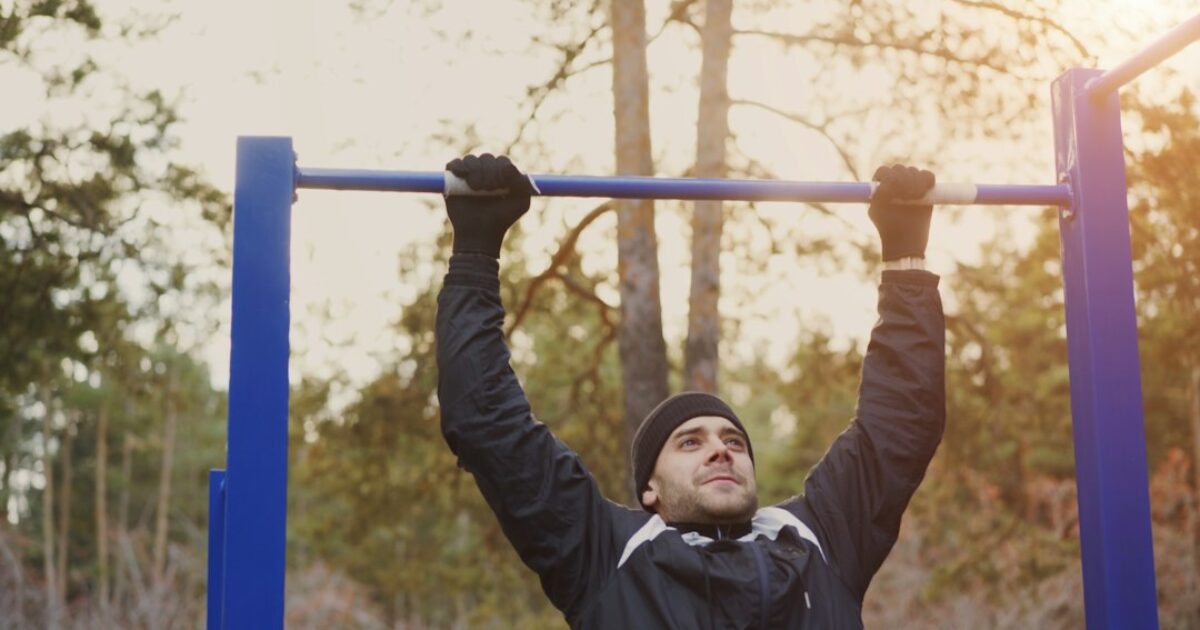
Hanging from the bar and going nowhere? You’re not alone: the pull-up is the bodyweight exercise beginners struggle with most. The good news is that it’s a matter of method, not talent. This guide on how to do a pull-up breaks the journey into 5 levels, RPG-style: you only move on once you’ve cleared the unlock condition.
Quick answer: train 3 times a week for 30 to 40 minutes. Starting from zero, expect 4 to 8 weeks to get your first strict pull-up, then another 6 to 10 weeks to reach 10 reps in a row.
What muscles do pull-ups work?
The pull-up is a vertical pulling movement. It mainly targets the lats, plus the rhomboids, middle and lower traps, biceps, forearms (grip) and the core, which keeps your body from swinging. That’s why it’s considered the king of back exercises in calisthenics.
Level test: where should you start?
After a proper warm-up, hang from the bar with straight arms and do as many strict pull-ups as you can (chin over the bar, no swinging).
| Test result | Your starting level |
|---|---|
| Can’t hang for 20 seconds | Level 1: Apprentice |
| Can hang 20 s, 0 pull-ups | Level 2: Squire |
| 0 pull-ups, but can control a 5 s descent | Level 3: Knight |
| 1 to 4 pull-ups | Level 4: Champion |
| 5 to 9 pull-ups | Level 5: Hero |
Level 1: Apprentice (hangs and scapular control)
Goal: build grip strength and learn to engage your shoulder blades, the foundation of every clean pull-up.
- Dead hang: 3 sets, max time
- Scapular pull-ups: arms straight, pull your shoulder blades down and together without bending your elbows. 3 x 8-10
- Australian pull-ups (inverted rows under a sturdy table or low bar, body at about 45°): 3 x 8-12
Unlock condition: 30 s dead hang, 10 clean scapular pull-ups, 3 x 10 Australian pull-ups.
Level 2: Squire (harder horizontal pulls)
- Inverted rows with a more horizontal body (feet elevated if possible): 4 x 8-10
- Jumping pull-ups: jump to get your chin over the bar, then hold the top for 2 s. 3 x 5
- Flexed-arm hang: chin over the bar, hold as long as possible. 3 sets
Unlock condition: 3 x 10 feet-elevated rows and a 10 s flexed-arm hang.
Level 3: Knight (negative pull-ups)
Negative pull-ups are the single most effective exercise for your first rep. Start at the top (jump or use a chair) and lower yourself as slowly as you can.
- Negative pull-ups: 4 x 3-5 reps, at least a 5 s descent
- Band-assisted pull-ups: 3 x 6-8 (heavy band, then medium)
- Inverted rows: 3 x max
Unlock condition: 5 negatives of 8 s each and 3 x 8 pull-ups with a medium band. At this point, test a strict pull-up at the start of each session: this is where it usually shows up.
Level 4: Champion (from 1 to 5 pull-ups)
You got your first pull-up: congrats, that’s the hardest milestone. Now build volume without hitting failure on every set.
- Low-rep sets: 6 to 8 sets of 1-2 reps, 90 s rest
- Negative pull-ups: 3 x 3 with a 5 s descent, at the end of the session
- Greasing the groove (optional): do single reps throughout the day whenever you pass your bar, always far from failure
Unlock condition: 5 strict pull-ups in a row.
Level 5: Hero (from 5 to 10 pull-ups)
- Ladders: 1, 2, 3, 4 reps with 30 s rest between rungs, repeat 2-3 times
- Chin-ups (palms facing you): 3 x max to vary the angle and build the biceps
- Feet-elevated or weighted inverted rows: 3 x 12 for extra back volume
Unlock condition: 10 strict pull-ups in a row. Quest complete: you’re ready to chase your first muscle-up.
8-week beginner pull-up program
Here’s a sample plan for someone starting at level 1. Train 3 days a week with at least one rest day between pulling sessions.
| Weeks | Level | Typical session |
|---|---|---|
| 1-2 | Apprentice | Dead hang 3 x max, scapular pull-ups 3 x 10, Australian pull-ups 3 x 10 |
| 3-4 | Squire | Feet-elevated rows 4 x 8, jumping pull-ups 3 x 5, flexed-arm hang 3 x max |
| 5-6 | Knight | Negatives 4 x 4 (5 s), banded pull-ups 3 x 8, rows 3 x max |
| 7 | Champion | Strict pull-up test, then negatives 4 x 3 and light band 3 x 6 |
| 8 | Champion | Low-rep sets 6 x 1, negatives 3 x 3, max test at the end of the week |
Add push-ups, squats and core work on other days, or follow our 8-week beginner calisthenics program, which already includes this work.
Mistakes that keep you stuck
- Half reps: start from straight arms and finish with your chin over the bar, or you won’t build strength through the full range.
- Swinging: kipping hides a lack of strength. Keep your legs together and your core tight.
- Training to failure every set: you pile up fatigue without getting stronger. Leave 1-2 reps in the tank.
- Training every day: your back and elbows need around 48 hours between hard sessions.
- Relying on bands for too long: they help most at the bottom. Always pair them with negatives.
What equipment do you need at home?
A doorway pull-up bar is enough for this entire program. Add a set of resistance bands for assisted reps. For inverted rows, a sturdy table or a low bar works fine. Outdoor calisthenics parks are a free option too. For the rest of your body, check our home workout program with no equipment.
Pull-ups for women: does the program change?
The exercises and levels are exactly the same. The only common difference is spending a bit longer in levels 2 and 3, since starting upper-body strength tends to be lower on average. Stick to the same logic: negatives and bands, then low-rep sets. A first pull-up is a very achievable goal.
Track your quest with RPGFitness
Clearing levels is more motivating when you can see your progress. RPGFitness, our free calisthenics app, turns every workout into XP: you level up, unlock skills and stay consistent thanks to gamification.
Keep going
- Calisthenics for beginners: complete guide
- Muscle-up progression: get your first rep
- How to learn the handstand
FAQ
How long does it take to do your first pull-up?
Starting from zero with 3 sessions per week, most beginners get there in 4 to 8 weeks. Body weight and training history affect this timeline.
Why can’t I do a single pull-up?
Usually your back and grip lack strength and scapular engagement is not yet automatic. Scapular pulls, Australian rows and negatives fix all three.
Negatives or resistance bands: which works better?
Negatives are generally more effective for the first pull-up because you work with your full body weight. Bands are a useful complement to accumulate reps.
How many times per week should I train pull-ups?
Three sessions per week is a good pace for beginners, with a rest day between each.
Pull-ups or chin-ups for beginners?
Chin-ups (palms facing you) are often easier because the biceps help more. Start with whichever you can do, then add overhand pull-ups.
Which app can I use to track a pull-up program?
RPG Fitness lets you log every pull-up set, track your records and turn the 5 levels of progression into a real quest: every session earns XP and loot for your hero. Free on iOS and Android.